
Committed Work Items Completed
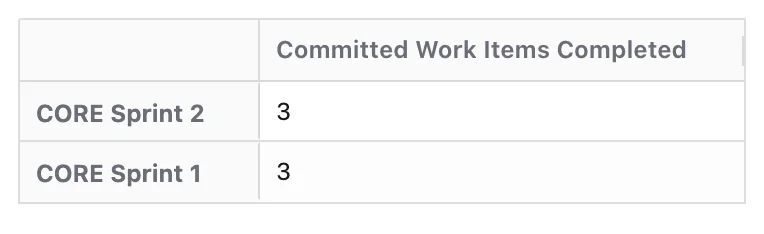
Committed Work Items Completed measures the number of distinct Jira work items that were part of the sprint commitment at sprint start and were completed by the time the sprint finished.
It represents how much of the originally committed work was delivered during the sprint.
This Metric does not measure total delivery volume, effort, or scope change. It focuses only on delivery against commitment.
What Question Does Committed Work Items Completed Answer?
Committed Work Items Completed is designed to answer:
How much of the work we committed to at sprint start did we actually complete?
How Work Items Are Counted
Committed Work Items Completed is calculated using sprint boundary snapshots.
A work item is included if:
- It was part of the sprint at sprint start
- It is in a status mapped to the Completed lifecycle state at sprint completion
Work items added after sprint start are excluded, even if they are completed. Each work item is counted once per sprint.
When a Time dimension is applied, sprints are grouped based on their completion time. Only sprints whose completion time falls within the selected time period are included. The Metric is calculated once per sprint and then aggregated across sprints. Work items are not deduplicated across sprints, as each sprint represents a separate commitment context.
Configuration
Committed Work Items Completed has no options of its own. Like every Metric it can be given a Metric Name and a Description — see Metric Configuration.
What You Can Analyse with Committed Work Items Completed
Committed Work Items Completed is commonly used to analyse:
Delivery Predictability
- How consistently teams deliver what they commit to
- Trends in meeting sprint commitments over time
Planning Accuracy
- Over-commitment or under-commitment patterns
- Stability of sprint planning across teams or projects
Execution Effectiveness
- Impact of scope changes on original commitments
- Relationship between sprint volatility and missed commitments