
Work Items Completed
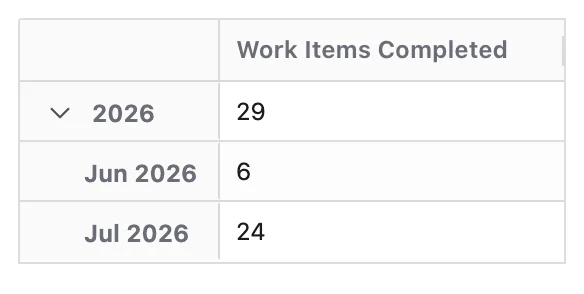
Work Items Completed measures the number of Jira work items that reach the Completed lifecycle state.
It represents the volume of work items finished based on lifecycle completion.
Only work items that have reached the Completed lifecycle state are included in this Metric.
What Question Does Work Items Completed Answer?
Work Items Completed is designed to answer:
- How many work items were completed?
- When were those work items completed?
By tracking this Metric over time, teams can see how delivery output is changing and whether completion patterns are stable, improving, or slowing down.
How Work Items Are Counted
A work item is counted when it transitions into a status mapped to the Completed lifecycle state.
- Only work items that reach the Completed lifecycle state participate in this Metric
- Each work item is counted once
When the Time dimension is applied, work items are grouped into time periods based on the latest time they entered the Completed lifecycle state.
This means:
- A work item appears in the time period that matches its latest completion date.
- If a work item moves out of Completed and later re-enters it, the most recent completion event is used.
- Later changes that do not move it out of Completed (e.g. comments, field updates) do not change when it is counted.
Configuration
Work Items Completed does not require any configuration.
- The Metric uses lifecycle mapping of statuses to the Completed lifecycle state.
- No custom date fields or additional workflow events are required.
For accurate results, make sure your workflows:
- Map all "done / completed / finished" statuses to the Completed lifecycle state.
- Use consistent transitions when work is actually completed, so the completion signal is reliable.
Its configuration panel offers no options of its own — only a Metric Name and a Description, as described in Metric Configuration.
What You Can Analyse with Work Items Completed
Work Items Completed is commonly used to analyse:
Delivery Throughput
Understand how much work your teams are completing over time:
- Total number of completed work items per day, week, month, or sprint
- Overall delivery volume across projects, products, or teams
Delivery Trends
See how completion is evolving:
- Increases or decreases in completed work over time
- Periods with unusually high or low completion
- Patterns around key events (e.g. releases, holidays, team changes)
Delivery Distribution and Mix
See where and what type of work is being completed:
- Breakdown of completed work items by work item type, priority, component, service, or area
- Distribution of work across different categories (e.g. feature work, bugs, or operational work)
Team and Ownership Output
Understand who is delivering completed work:
- Completed work by team, assignee, or project
- Comparison of delivery output across teams or product areas
Flow Stability Indicators
Use completions as a signal of flow quality and stability:
- Compare completed work with reopened work items
- Identify areas where work frequently reopens after completion, indicating instability or quality concerns
Capacity and Balance Insights
Use Work Items Completed alongside Work Items Created:
- Compare completed work items with created work items over time
- Detect backlog growth (creation > completion) or backlog reduction (completion > creation)