
Work Items Overdue
Work Items Overdue measures the number of unfinished work items that have passed their Due Date.
It represents the volume of overdue work in the system, using the work item's Due Date as the reference point and checking if the current date is past that due date while the item remains incomplete.
This Metric focuses only on counting overdue work items. It does not consider:
- Effort or story points
- Workflow duration or time to complete
- Already completed or closed work items
What Question Does Work Items Overdue Answer?
Work Items Overdue is designed to answer:
- How many work items are currently past their due date and remain unfinished?
- Which teams, priorities, or work types have the highest concentration of overdue work?
By tracking this Metric, teams can identify bottlenecks, manage SLA breaches, and address delayed deliverables.
How Work Items Are Counted
- A work item is counted if it has a Due Date specified, that Due Date is in the past (before the present date/time), and it does not have a mapped Completed Date (i.e. it is not yet completed or closed).
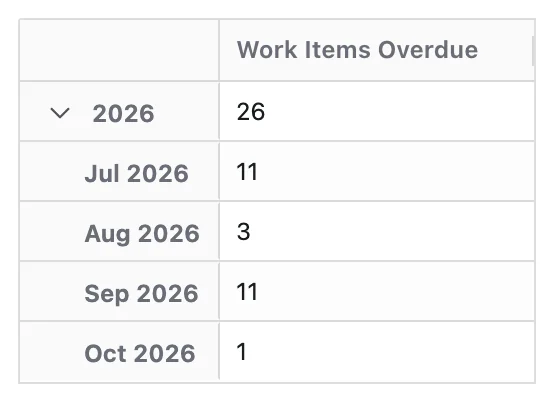
- When the Time dimension is applied, work items are grouped into time periods based on their Due Date.
This means:
- A work item appears in the time period that matches its Due Date.
- Only currently unfinished items whose due dates have passed are counted.
Configuration
Work Items Overdue does not require complex configuration.
- The Metric uses the standard Jira Due Date (
duedate) field. - It uses Lifecycle Mapping to identify completed/closed items (based on the
[derived]completedDate).
Its configuration panel offers no options of its own — only a Metric Name and a Description, as described in Metric Configuration.
What You Can Analyse with Work Items Overdue
Work Items Overdue is commonly used to analyse:
Overdue Trends
Understand how delayed work changes over time:
- Total count of overdue work items at any given point.
- Growth or reduction of overdue work, indicating whether the team is catching up or falling further behind.
Delivery Risk Distribution
See where the delay is concentrated:
- Which projects, spaces, or assignees have the most overdue items.
- Breakdown of overdue items by:
- Work type (e.g. bug, story, task)
- Priority (e.g. blocker, high, medium)
- Component or area
Flow and Capacity Signals
Identify potential blockers or capacity constraints:
- Sudden increases in overdue items, indicating resource bottlenecks or unrealistic planning.
- Re-evaluate due date assignments and team capacity based on historical overdue rates.